
When geopolitics becomes a business issue
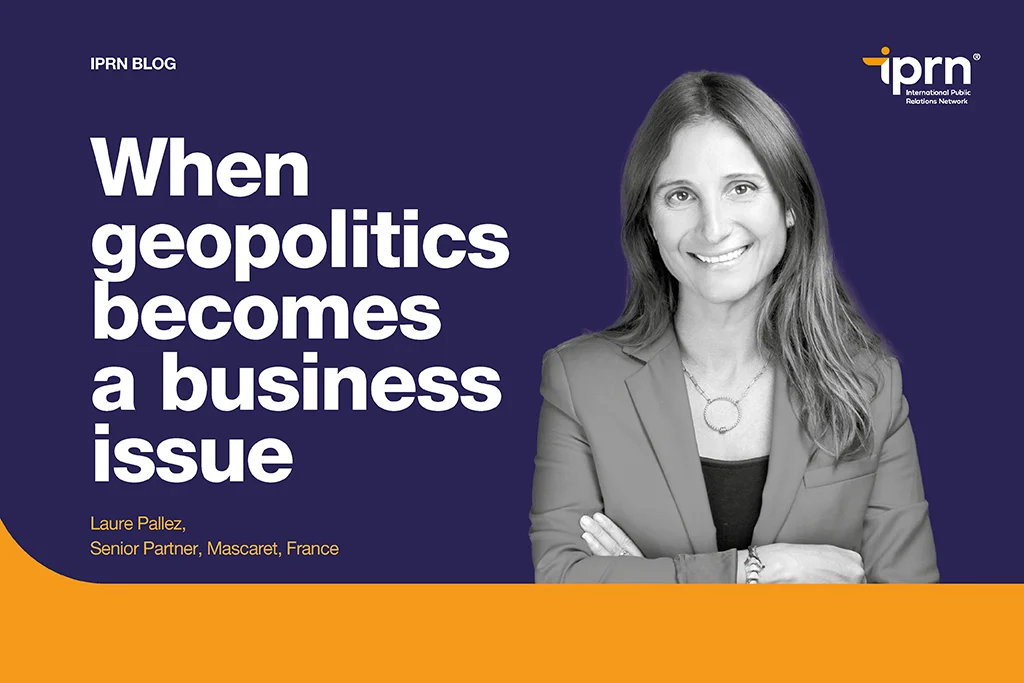
Laure Pallez, Senior Partner of Mascaret, IPRN’s member agency in France, explains in this interview how communications teams can identify exposure, understand stakeholder reactions and respond without losing sight of local realities.
Geopolitical risk is no longer separate from business strategy.
A political or military development in one market can disrupt supply chains, increase operating costs, restrict access to technology or change the conditions under which an organisation can invest and trade. It can also create an immediate reputational question: what does the organisation know, what is it doing and what position does it appear to represent?
The World Economic Forum’s Global Risks Report 2026 identifies geoeconomic confrontation as the most significant risk over the next two years. For communications and public affairs teams, this means that monitoring events is no longer enough. They must help organisations understand how political developments could affect their operations, stakeholders and reputation.
This requires judgement before complete information is available. Communicating too quickly can create legal, political or reputational exposure. Waiting too long can leave employees, customers, regulators and the media to interpret an organisation’s silence for themselves.
The challenge becomes still more complex across borders. A message considered responsible in one market may be understood differently in another because of local political relationships, historical experience or media narratives.
To examine how organisations can prepare for this environment, we spoke with Laure Pallez, Senior Partner at Mascaret, IPRN’s member agency in France.
Laure has 20 years of experience in public affairs, international trade, finance and cross-border business. Her career has included senior positions at the Institut Pasteur in Shanghai and the French Embassy in Washington, DC, where she served as economic adviser to the French Ambassador.
In this interview, she explains what teams should assess when geopolitics begins to affect the business, how organisations can communicate under uncertainty and why international strategy depends on credible local intelligence.
1. When a geopolitical crisis becomes a business issue, what should public affairs and PR teams look at first?
Public and media relations are no longer just about reacting to geopolitical events. They are about anticipating and explaining their business consequences.
Reflecting this shift, strategic communications consultancy has become the largest PR service category, accounting for 26% of the market in the IPRN 2026 PR Business Survey.
Practically, it is key to assess three dimensions simultaneously: exposure (which markets, suppliers and routes are vulnerable), stakeholders (who will react and how), and narratives (what stories are forming).
The 2026 context makes this especially urgent: WEF’s Global Risks Report found geoeconomic confrontation ranked as the top short-term risk and 50% of experts expect a “turbulent” environment over the next two years and that was in January 2026, that is before the Iran war.
Today, major international disruptions fueled by the ongoing war in Iran have overtaken artificial intelligence as the greatest risk to corporate brands, as Reuters reports that the conflict is driving up costs, disrupting supply chains, and clouding companies’ financial outlooks, with many firms forced to raise prices or revise guidance in response to the shock.
This environment tends to push companies to reassess how they allocate their limited budgets, often shifting spending from broad marketing activities toward PR and communications.
Indeed, Gartner reported that marketing budgets fell to 7.7% of revenue in 2024, down from 9.1% in 2023, suggesting that communications can gain relative priority when marketing spend comes under pressure.
Gartner also expects PR budgets to double by 2027, as AI-driven search increasingly rewards the brands that have invested in visibility, media coverage, and strong press relations.
If you do not pay attention to geopolitics, geopolitics will pay attention to you – to paraphrase Léon Trotsky.
2. How should organizations communicate when the political context is volatile, but silence is also risky?
In 2025-2026 commercial policy tools (tariffs, export controls, secondary sanctions, national security…) are being used as instruments of statecraft, so a company’s silence or an inconsistent message can quickly become a regulatory or reputational risk.
Avoid the twin traps of overreaction and disappearance. In the first hours, stakeholders do not demand perfect answers; they expect awareness, honesty, and consistent updates on what you know and what you are monitoring.
That discipline preserves credibility in environments where messages can be reinterpreted politically. In instability, silence is rarely neutral.
At the same time, reputational risk is no longer isolated. Armed conflict now feeds into cyberattacks, inflation-driven pricing decisions, workforce tensions and AI-related governance issues meaning every communication sits within a broader web of scrutiny.
Reduced trust tied to accelerated AI adoption is also still one of the top risks facing organizations, and pressure from governments remains a major issue.
The Anthropic case is a good example: the US administration’s decision to label it a supply chain risk the first time that designation had ever been used for a domestic company showed how fast AI policy can become a reputational issue.
Yet the company emerged stronger by sticking to its red lines, and Claude (AI assistant developed by Anthropic) became the most downloaded app on the App Store after the crisis.
3. What role does narrative play in modern geopolitical crises?
Narrative is now a primary battleground. Crises unfold simultaneously on the ground, in markets, and across social media; perception often moves faster than facts and can harden before evidence is complete.
The critical question shifts from “what happened?” to “who gets to explain what happened?” Whoever frames the first credible narrative shapes subsequent interpretations and policy feedback loops.
In the current environment, even legal and operational decisions are read through a geopolitical lens. The Iran sequence illustrates this: what began as a regional crisis has been read as part of a wider Asian and geoeconomic reconfiguration: “the Iranian tree that hides the Chinese forest” showing how local incidents can be reframed into continental strategic narratives (May 31, 2026 bulletin).
Narrative is not a soft power add-on, it is strategic power. If you don’t tell your story, someone else will!
4. How can public affairs teams prepare clients for indirect consequences rather than direct political shocks?
The goal is not perfect prediction. The goal is preparedness—so the organisation is not seeing the chain of events for the first time when it becomes reality.
The current environment makes this even more concrete: inflationary pressure is forcing difficult pricing decisions, hiring freezes are emerging due to uncertainty, and consumer behavior is shifting in response to rising costs, all of which erode trust and reputational resilience over time. In other words, the headline is rarely the full story; the real risk sits in the ripple effects.
Recent intelligence shows concrete examples: a potential post-conflict reconstruction in Iran (discussions of a $300B fund, June 25, 2026) creates opportunity scenarios but also reputational and legal questions about frozen assets and local partners; Ormuz reopening could become a revenue and sovereignty lever for Tehran, with knock-on effects on shipping, insurance and energy prices.
Geopolitical shocks rarely stay at the level of the headline. They quickly affect supply chains, investment decisions, contracts, and market confidence, which is why public affairs teams need to look beyond the immediate event and prepare for the indirect consequences it can trigger. The direct shock is rarely the real cost.
5. What does this crisis teach global PR networks about local intelligence?
Geopolitics is global but reception is local: the same message landing in Washington, Berlin, Dubai or Taipei will be filtered through different histories, sensitivities and decision-making networks. Global coherence is necessary, local adaptation is essential.
Local intelligence isn’t only translation; it means mapping local power networks, media ecosystems, regulatory levers and public opinion drivers before you deploy a global narrative. The strongest networks combine a single strategic frame with locally credible execution teams.
Taiwan’s rising centrality in U.S. imports and Ormuz’s new potential as an Iranian geo-economic asset change how local markets perceive systemic risk and what local audiences expect from companies operating there.
Political pressure and regulatory scrutiny are now unevenly distributed across jurisdictions, with some companies facing direct targeting or backlash depending on their perceived alignment. That reinforces the need for locally grounded judgement, not just globally consistent messaging. One message, many local readings.
Related
As a central piece of the country’s nation-branding process initiated [...]
4 min read
25 October 2016
The agency specialized in tourism promotion, Comunicación Iberamericana, will implement [...]
1 min read
29 November 2017
WeChat, the first of a series of brand advertisements on [...]
2 min read
23 February 2015
IPRN Business Survey
Our annual research highlights the evolving communications landscape and explores the challenges, opportunities, and emerging trends shaping the future of the industry.
