
Culture as Influence Currency: Why Ojude Oba Is More Than a Festival
I was sitting knackered and quite fatigued from the Eid festivities, but still travelling the world through my phone on that Friday morning when it hit me.
It wasn’t a policy brief. It wasn’t a brand report. It wasn’t even a think-piece. It was a photograph.Then another.Then a video.
Then more photographs bursting with colour, elegance and pride. A man on horseback, draped in the kind of regalia that stops your breath mid-scroll. Behind him, a sea of colour, precision and pageantry so striking it looked almost choreographed. The shares were in their thousands. The comments were relentless. The admiration was global.
It was Ojude Oba. And the world was watching. In that moment, I wasn’t thinking about heritage. I was thinking about power.
And proudly so. As an Ijebu woman, I could not help but smile at how a tradition rooted in our history had managed to command the world’s attention yet again.
We Have Been Measuring Influence Wrong
For most of my career in marketing and communications, influence has been framed through familiar variables: budget size, media reach, share of voice, political capital and market presence.
As professionals, we have built strategies around these metrics. We have justified them to clients, defended them in boardrooms and measured success through them.
Yet something about those photographs make those metrics feel incomplete. What I was witnessing was influence operating entirely outside the traditional framework.
No paid media campaign had manufactured it.
No agency had been briefed.
No influencer had been contracted.
And yet, here was a centuries-old Ijebu tradition commanding the voluntary attention of a global audience.
That is not entertainment.
That is influence.
That is soft power in its most organic form.
The concept of soft power — the ability to attract and influence without coercion — is not new. Decades ago, political scientist Joseph Nye introduced the idea to explain how nations shape global perception beyond military or economic force.
What he described in geopolitical terms, Ojude Oba demonstrates in cultural ones.
Hollywood did not accidentally become a foreign policy instrument. It was recognised, funded and strategically amplified. K-Pop did not stumble into a multi-billion-dollar global industry. South Korea deliberately invested in music, film, fashion, food and storytelling, and watched as millions around the world became emotionally invested in a country many could not have located on a map a generation ago.
For too long, Africa has appeared content to watch from the sidelines. Yet we have always possessed the raw material. What we have often lacked is the strategic imagination to recognise its value.
What Ojude Oba Is Actually Doing
Let me be specific, because generalisation is where good arguments go to die. Every year, Ojude Oba draws tens of thousands of people to Ijebu-Ode — not because it is aggressively marketed, but because it is meaningful.
The regberegbe groups, representing generations of Ijebu sons and daughters, arrive in coordinated splendour. The horses. The drummers. The fabrics. The hierarchy. The rituals.
Every element of the festival is a deliberate act of identity assertion.
And identity, when expressed with confidence and consistency, becomes magnetic. In fact, culture is what a people wear when nobody is watching. Influence is what happens when the world starts watching.
Think about what happens downstream.
A fashion designer in Lagos sees the coverage and draws inspiration.
A travel journalist in London pitches a feature.
A Nigerian diaspora professional in Houston forwards footage to colleagues who have never heard of Ijebu-Ode.
A brand manager begins questioning whether they have overlooked one of the most culturally relevant partnership opportunities in the country.
A foreign investor, building a mental picture of Nigeria beyond economic headlines, gains a perspective that humanises what the numbers alone cannot.
None of this is accidental. All of it is influence. And the economic multiplier is real.
Cultural events of this scale activate entire ecosystems — hospitality, transportation, food, fashion, photography, content creation, artisanship and commerce.
Hotel rooms sell out weeks in advance. Restaurants, vendors, designers and service providers all benefit from the influx of visitors and spending.
The naira spent during a 48-hour festival circulates far beyond the festival itself.
But perhaps more importantly, the attention generated extends the value indefinitely. In a content-saturated world where attention is one of the most expensive commodities available, Ojude Oba earns it freely, year after year after year.
The Question No One Is Asking Loudly Enough
If culture is this powerful, why are we not treating it like the strategic asset it is?
This is where I want to challenge us — particularly those of us in business, communications, development and public policy.
We speak endlessly about investment climate. About Brand Nigeria. About diaspora remittances. About foreign direct investment. But how many of those conversations include culture as a serious line item?
How many national branding initiatives are built from cultural truth rather than toward it?
The global rise of Afrobeats, the increasing visibility of Nigerian fashion and the emergence of cultural personalities who command international attention are encouraging signs. But we are still scratching the surface.
The societies that have truly understood the relationship between cultural identity and economic influence have not left it to chance.
They institutionalised it. They funded it. They protected it. And they told their stories with intention.
We have extraordinary stories.
The question is whether we are telling them with the same seriousness we bring to everything else we consider important.
Ojude Oba is not waiting for permission. It is already doing the work. The rest of us need to catch up.
What I Want Us to Take Away
I am not suggesting that every cultural festival is an untapped goldmine. Nor am I suggesting that heritage should be commercialised without care. Culture must be protected even as it is leveraged. That tension is real and worth holding.
What I am suggesting is this: The next time you see a cultural event commanding global attention, do not merely admire it.
Analyse it.
Ask what it is doing that a media buy cannot.
Ask why people are sharing it voluntarily.
Ask what it is communicating about the people behind it.
Ask whether those people — whether we — fully understand the value of what we are sitting on.
Because the world is not waiting for Africa to discover its worth. It is already paying attention. The more urgent question is whether we are paying attention to ourselves.
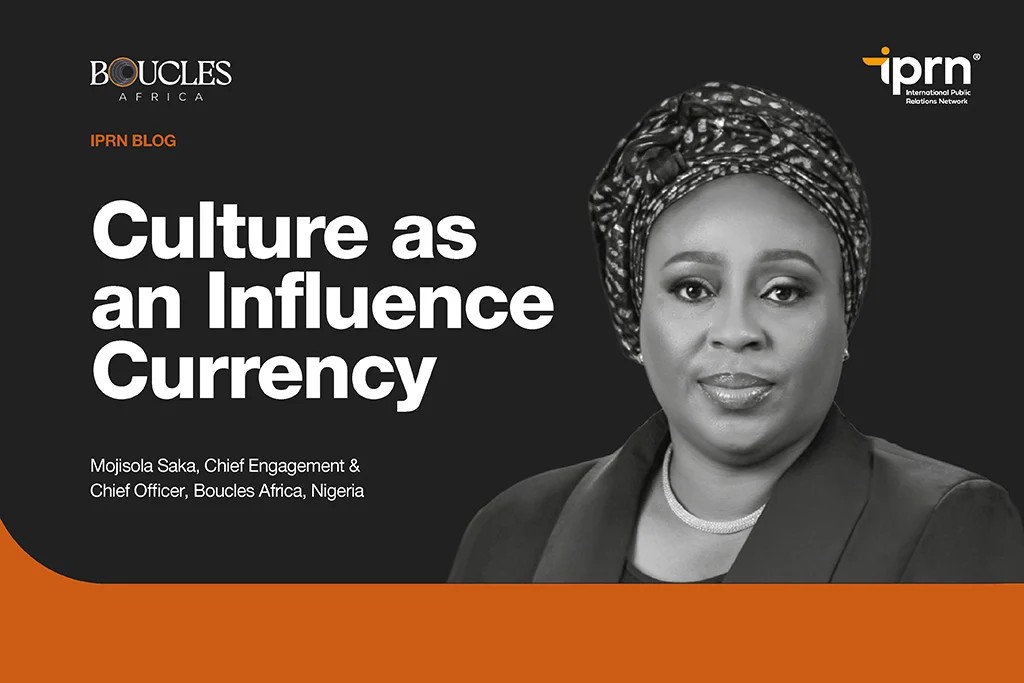
Mojisola SAKA is the Chief Experience & Engagement Officer of Boucles Africa Limited, an integrated marketing communications consultancy based in Lagos, Nigeria. This article is an output of her thought leadership series, ”The Way I See It”, where she explores influence, culture, reputation, leadership and the ideas shaping Africa’s future.
Related
I’m a bit fired up. Jan Gusich February [...]
4 min read
27 March 2015
Re-invention of medicinal ingredients. Medicinal ingredients look set to get [...]
1 min read
22 February 2016
Communication has changed – and continues to change. The influence [...]
3 min read
17 May 2019
IPRN Business Survey
Our annual research highlights the evolving communications landscape and explores the challenges, opportunities, and emerging trends shaping the future of the industry.
